Showing posts with label deaths. Show all posts

Thursday, 2 December 2010

Orca breeding today

    Hello and thank you to my fourth follower! It brings yet another tear to my eye, so thank you :)
 But first, on Orca Network's Facebook page, a very injured whale has been spotted around Puget Sound. Take a look at the info, and if you know of anything to help, please do it, as it is in a very very bad way.

And also, please can you email the Prime Minister of Iceland, begging for them to reclaim Tilly and order SeaWorld to return him to his home waters. The address is: postur@for.stjr.is
 Thank you!
 
    So, onto the next topic, where I will be talking about how the captive orca industry has shaped and developed orca breeding in this day and age. I will be mainly focusing on and explaining the process of artificial insemination, the use of breeding bulls such as Tilikum, and the problems that may arise with any captive female or male orca who are used for the captive breeding programs in such marine park establishments. I apologise for any information that may not seem quite as concise as the marine biologists out there would expect, but I am just trying to illustrate how demeaning this side of the industry really is.

    Firstly, what on earth is AI and how and why is it used? Well, AI stands for Artificial Insemination, and it is a practice that facilitates the meeting of a sperm cell and an egg without the process of actual intercourse. It is used for humans as well as within a variety of animal industries, such as: dog breeding; horse racing; zoos; circuses; the dairy and meat industry; and of course, marine parks. It is used in the marine park industry as transporting the bull (male) orca from park to park would cause stress on the animal, so it is easier and cheaper for them to just get a sperm collection on-site. However, bulls are still transported from place to place on 'breeding loans', which means that they are shipped to any place that wants a bull who can perform on-site, on-demand and produce calves from intercourse. So surely this defeats the point of AI? As bulls are still taken from their homes and put into new temporary ones, which means they are still stressed and moved about, despite the use of AI being so available, not that AI is any better morally or ethically, which is what I am here to illustrate. It may be a case of the marine parks wishing to proclaim that their pregnancies are natural ones as this will give off a certain image- that they are ethical and letting the orcas chose who they breed with. It is of course very profitable for the park leasing out one of their bulls, which may be what the incentive is.

     However, AI is also used so predominantly in the industry now as it allows for gene pools to be mixed, and also for greater selection over who breeds with who. So instead of natural breeding, where they choose their own mate, they must be trained or sedated for the semen collection process, in order for it to be inserted into any female the park chooses. This semen collection can be done in one of two ways, either by masturbation or electroejaculation. The masturbation method takes a bit of training, as it relies on  positive reinforcement and operant conditioning (which is the modification of voluntary behavior) to get its result. The male orca is first shown and introduced to a receptive female orca, and when he shows some of his penis and becomes receptive to the female, he is taken away from her and expected to ejaculate. It was hard to get a clear and concise version of this training process, despite looking through various papers and articles. It seems as though they want to keep they way they train it on the down-low. But from what I can gather, it seems that they leave it till the male is very receptive and then lead him away and ask him to roll onto his back. They then touch his penis in order for him to ejaculate into a bag, and when he does so he is given the positive reinforcement. This is the operant conditioning that modifies his voluntary behaviour (ejaculation) by using positive reinforcement. After several training sessions, the male will be expected to roll over and pronounce his penis and ejaculate into the bag, and all at only the sight of the bag. His sperm will then be stored in a freezer or inserted straight into the female. A video of this method can be seen here. Notice how pitiful and pathetic this huge bull seems. It is as if he has just thrown in the towel, and thrown away his dignity. He just swims over sheepishly, rolls over, and is assaulted and then has his semen robbed from him. How such a huge, powerful, majestic being can be reduced to a sperm-production unit is beyond belief.

    The female's training is much the same- she will be trained to roll over and accept the insertion of the sperm into her vagina whenever she is mature. This should be at 15 years old, however SeaWorld impregnated a 7 and a half year old Kalina, which was far too young to be having a pregnancy, as she was only half the age she should have been. The female will then be made pregnant every 3 to 5 years. The other way of AI is to use electroejaculation, which involves the male being sedated, while an electric probe is inserted into his rectum, next to his prostate. An electric current is then delivered, which leads to a contraction on the prostate and pelvic muscles, leading to ejaculation. This form of semen collection is not as common, as obviously it raises some huge ethical questions, and quite frankly the marine parks do not want that on their backs. They would much rather say that their orcas are voluntarily producing their semen and they are under no drugs or force to do so. But lets face it, orcas are extremely intelligent and emotional beings, they know when they want to reproduce, as they stay with their young throughout their whole life. So they know that what they are being made to do is wrong. They are coerced into it using food and they are forced to comply or they would not get the 'positive reinforcement' i.e. food, that they so crave. Instead, what this practice is, is effectively an assault. These animals know what they should be doing, they know what  they are entitled to. They are forced to perform on cue using the plastic bag, without any emotional or sexual stimulation from a female orca, let alone one that they have chosen for themselves. This is not ethical, and it is not fair.

   The female orca also gets this same immoral treatment, as all of a sudden, without any knowledge or consent, she finds herself pregnant. This is tantamount to rape, as in the orca world they choose when they wish to reproduce, they choose who they reproduce with and they cherish their offspring just as much as any proud human mother would. So when, after their gestation period which could be up to 18 months, a baby pops out, imagine the shock she must feel? I know she will love and look after her child, but all she must be thinking is: 'where did that come from?' Not only that, but during the whole birth there are various people and experts and vets around, gawping, some even in the water. Surely she should at least have some privacy in the most intimate time of her life?


A baby and her mother with a trainer involved already. Do they get no peace? (Photo from angelfire.com)


    Not only this, but after the birth the calves are expected to be getting accustomed to the trainers and the ways of a captive life- dead fish, training, no natural swimming, no natural ocean sights and sounds, and just a few tank members. Not a proper family pod like they would have in their natural habitat. How is this so widely accepted? To produce baby orcas and whole new groups of orcas, with no consideration for their own family bonds, choices or the fact that in the wild they all stay together for their whole lives? Instead these young ones must be in a tank with just a few random other orcas, not necessarily their sisters, brothers or father. It is not even guaranteed that they will be allowed to stay with their mother the whole time. For instance, Shouka who was moved from Marineland Antibes to Six Flags of Ohio in 2002, away from her mother Sharkan and brother Val, and also away from her father Kim II, with whom she had developed a strong bond. She is now all alone, still at Six Flags, with just 2 bottlenose dolphins for company. This is no life for a young female, who was so close to her family back in Antibes. At least there she could live out her sorry captive life with the support of them, but now she has to go it alone. Another example of family bonds being ripped apart would be of Kalina and Keet, when Kalina was moved away from Keet in order for her to accommodate another pregnancy. Keet was only 1 year and 8 months old at this time, and it is almost unbelievable that SeaWorld would allow for this to occur, as it is known that orca pods and families are matrilineal- meaning the males will stay with their mother for their whole lives.


Shouka alone in her tiny pool, with no family members for company or support.
(Photo from theorcaproject.wordpress.com) 

     
     The use of breeding bulls is an unfair and unethical practice too. As I have discussed earlier, the means by which they are trained and used and exploited for their semen is far beyond fair, humane and just- whereas the use of Tilikum for his sperm is even more so. He is an orca that is dying to be free. He needs to be free. He has been trained for AI since 1999, that's 11 years of degradtion. He is constantly objecting to his life in captivity and yet no one will listen. Instead, he is all alone, with no proper orca companionship or interaction, and now due to his 'reputation', no human interaction or stimulation either. He is reduced from a huge, powerful and all-encompassing being, to an on-tap sperm bank. This is not the life he needs to live. It is unfair and so demeaning for such a magnificent animal. 


Tilly all alone in his pool, with no friends or family to support him. I can only imagine what he is thinking and reminiscing about. (Photo from Free Tilly Facebook page)


     This human dominance over the lives, and indeed births, of captive orcas is not without its complications and tragedies. There have been so many countless still-births, deaths of mothers, and premature passings of calves it is a wonder places like SeaWorld can still proudly proclaim that their captive orca breeding program is one of the best in the world. Many mothers have died during labour and child-birth, and many calves have died through complications during birth or soon after. A few examples of such tragedies are: 
- Gudrun, who died in 1996 due to complications with a still-birth.
- In 1998 Sumar was born to Taima, who was her first calf. However, when he was just 6 months old, Taima tried to attack him and bit him during a show at SeaWorld. Which begs the question, why was she performing? They should have both been in a separate pool to the shows, in order to bond under less-stressful and agitated circumstances. The noise of the crowd, the splashes, the silly tricks. He does not need to be around that at such a young age, and his mother needed to be around him in private so they could have some intimate bonding time. No wonder she lost it and attacked, she must have felt so stressed, being a new mother expected to perform instead of bond with her baby.
- In 2005, Kayla gave birth to a female called Halyn. However, Kayla did not take to the calf and did not      know what to do, so Halyn had to be taken away and hand-raised at a special facility. It is thought that Kayla did not know what to do as she had never been around a calf before, and had never seen mothering be done. Of course, if she were in the wild this would never have happened, as she would have had one-hand help from her own mother and pod all the way. A member of the pod would of even been with her at the birth.
- In 2008, Hayln died unexpectedly, aged just 2 and a half. This raises a lot of questions about the success rate of birthing at marine parks- and indeed of hand-raising.
- Sadly, in June of this year, Taima died during a birth, aged nearly 21. She had a still-birth because the placenta was delivered before the calf. This was not the only stress put upon poor Taima while in her short captive life, as not only did she become aggressive to Sumar, she also became aggressive to her other son Tekoa, who was born in 2000. She was swimming with him and Katina when she suddenly lashed out at Tekoa. Katina, who was pregnant at the time, then tried to get involved to protect him, but Taima then turned on her. Katina was so hurt and distressed by the incident that she was very lucky she kept her baby. It is a wonder why SeaWorld still insisted on getting her pregnant, despite two very aggressive and dangerous incidences in which she tried to hurt her own child. This sort of behaviour is very rare in the wild, and again proves how negligent and inconsiderate the marine parks are when breeding orcas. They should have left Taima alone, but instead impregnated her further, which ultimately caused her death.
 - In October of this year, Kohana (who was 8 at the time and so also very young to be impregnated) gave birth to a male calf after a four hour labour. However, she did not take to him and that prompted staff to take him away and hand-raise him.


    It seems as though the captivity industry has not yet showed the compassion that it so desperately needs when regarding the future lives of orcas, as they seem to just impregnate here and there, whoever and wherever and whenever they choose. They have even created hybrid orcas, such as Kalina, who was half Icelandic and half Southern Resident, and Taima who was half Transient and half Icelandic. This would not happen in the wild, and will no doubt have some negative consequences in the near future, as certain gene pools and matrilineal lines will be wiped out. There are also risks of inbreeding, as Kohana's calf was fathered by Keto- her half uncle. Not to mention the use of birth-controls and hormones which are pumping them full of medication and chemicals, and not to mention the fact these parks let young females become pregnant, even if they are too young. There are just too many arguments against captive orca breeding, yet the only argument for it is to restock the empty tanks where they are all dying at abysmally high rates, which to be frank, is not a good enough reason to allow it.

    So that concludes this post, hope it's been informative and highlighted some of the key moral and ethical arguments against captive orca breeding programs. Thanks for reading :)
And if anyone has any more details regarding the topic, please feel free to comment.




Thursday, 21 October 2010

Plan for post topics, and Dolphin Captivity

I was having a think last night and have come up with a rough plan of the topics I will be covering, and in what order. I think this will be best:
1. Taiji
2. Dolphin captivity and implications
3. Lesser publicised slaughters
4. Dolphin and orca intelligence
5. Orca captures in the past
6. Orca breeding today
7. Orca captivity and implications
8. Mortality rates in captivity
9. Famous cetaceans
10. Navy use of dolphins and whales, and dolphin therapy.
11.Whaling and the IWC
12. Current campaigns
13. List of dead, killed and living captive cetaceans
14. Shark finning, and shark product industry
15. Galapagos Islands
16. Current shark campaigns
17. Key cetacean and shark breeds

  And before you say 'hey sharks are not cetaceans!'- yes I know, but I think that their welfare and the issues surrounding them at the moment are just as relevant to any cetaceans. And to be honest I just really like sharks too, so thought I would include them to help get the word out about shark finning.

 So onto the next topic, dolphins in captivity and its implications. This is such a huge topic and deserves a huge post, so here goes. At the moment there are thousands of dolphins in captivity, in all the far reaching corners of the world. There is such a demand for them nowadays, and people just cant get enough. There are swim with dolphin programs, therapy, shows, you name it. Its as if every little girl now wants to be a dolphin trainer, or an orca trainer, and it is so sad to know how little they really know. This craze seemed to have started when the Flipper show was being aired on TV way back in the 1960s. It portrayed dolphins as intelligent, happy creatures that craved human contact and would risk their lives to save them. Like a cetacean Lassie almost. The role of Flipper was shared between several dolphins, but the main dolphin used was a female called Cathy. She and all the other 'Flippers' were trained by Richard (Ric) O'Barry, who back then was an aspiring young trainer based in Miami Seaquarium. He soon became a very famous trainer and was at the top of his game, that was until the death of his beloved dolphin Cathy. It was after the last series had finished that Ric had begun to notice she was looking depressed. It was then that she committed suicide in his arms. As he explained to Oprah Winfrey: 'She was really depressed... You have to understand dolphins and whales are not [involuntary] air breathers like we are. Every breath they take is a conscious effort. They can end their life whenever. She swam into my arms and looked me right in the eye, took a breath and didn't take another one. I let her go and she sank straight down on her belly to the bottom of the tank.' A heart-felt interview with Ric about the incident and about his work on Flipper can be seen here. It was from this point that he became a dolphin and whale activist, releasing and helping to liberate countless other captive dolphins. The argument that dolphins can commit suicide may indeed seem a far-fetched one, but it is not unknown that their emotional and indeed intellectual capacities are not far off our own, so suicide may in fact be a viable explanation for several incidences involving dolphins, and other cetaceans. 

       Recently there has been the story of the false killer whale jumping out of its performance tank in Japan. It attempted the leap once and failed, and then succeeded on the second try while his pool companions watched on in horror. It is safe to point out that the false killer whale was obviously aware of the implications of his actions- he could plainly see there was no water on the other side of the glass. So why did he try and escape? Ric argues that it was a suicide attempt, and it is one opinion that I would agree with. You can see the video of the incident here. Another interesting article on the idea of dolphin suicide can be found here. Another important point to raise here would be the story of Hugo the captive orca. He was originally captured in 1968 and was taken to Miami Seaquarium. He was used to keep Lolita company (more about her in the Famous Cetaceans topic), yet began to behave aggressively in shows. He eventually went into a very traumatised and depressed state, continuously banging his head on the tank wall, resulting in several serious injuries. He eventually had a brain aneurysm that caused his death in 1980. More on Hugo here.

Hugo being lifted after his death. (Photo from Google images)

So, captivity- what exactly are its implications on the dolphins it holds onto? Well, lets start with the living conditions for these dolphins. According to US regulations, a dolphin tank needs to be at least 30ft by 30ft, and 6ft deep. So that means in order for a dolphin to swim the length it does in the wild everyday, up to 50 miles, it would have to swim around the tank about 1700 times. Also, when you think that two or more dolphins may be sharing the tank at any one time, it makes the guideline size look like a swimming pool. The chemicals used in the tanks are also incredibly harmful, as they are difficult to keep clean and sanitary. The mental implications these small, boring tanks have on captive dolphins are extremely detrimental, and will be discussed later in this post. 

       The other important thing to consider when discussing captivity is of course the mortality rate, which is beyond justification. Dolphins die at an unbelievable rate when in captivity, from disease, depression, the squalid conditions, performance accidents, the list goes on. They are merely expendable commodities, their deaths do not matter, just as their lives do not matter. They can be replaced in a number of days and they are completely expendable. Some examples of deaths and causes of death are collisions during performance, one of which resulted in the death of 30 year old Sharky at Discovery Cove in 2008. They were performing a trick in mid-air and collided, resulting in the death of Sharky. This is purely unacceptable, to die whilst performing a trick for the public? It is immoral and beggars belief as to why they continue these shows. Anyway, I shall try and keep my rant to a minimum and just deal with the facts. Another death that was insignificant to the dolphinarium industry, yet so important to those opposing it, was the death of Poncho the dolphin at Miami Seaquarium in 1982. They found an array of objects in his stomach and it is a wonder her survived as long as he did, as they had obviously been in there for some time. A picture of this can be found here. It is no wonder why they wanted to keep that one hidden. More recently however, has been the deaths of four dolphins in the dolphinarium called Sealanya in Turkey. They all died within a week of each other, the reason yet is still unknown I believe. Although it will be surprising if any reason comes out at all, as it is in the interests of the park that they stay quiet. A very good news report on the full story can be found here. It is important to point out that these dolphins, and the others still at the park (and indeed all throughout Turkey) are from the drive hunts in Taiji. As quoted in the news article, 'They died psychologically while heading for Turkey'. A more successful story is that of Misha and Tom, two bottlenose dolphins trapped in a tiny 11m by 22m swimming pool in the middle of the Turkish town of Hisaronu. The conditions were appalling and they had endured 5 years of being fed frozen fish and floating on stagnant water before being brought to the attention of the Born Free Foundation. They have now been rescued and are currently living in a sea-pen. It just goes to show what public pressure can achieve. It is also important to include the recent death of Kalina the orca too, which unsurprisingly has not had a full explanation yet. She died at Seaworld Orlando on the 4th of October.


 Dolphins quite literally jumping through hoops at Sealanya. (Photo from Google images).


      When considering captivity, it is often a common assumption that these dolphins and orcas live in lovely, clean, bright blue waters, with the best health care and experts on hand. This is not always the case, especially in countries with lesser implicated animal rights, such as Egypt, Dubai, Korea, and as discussed earlier, Turkey. One of the most infamous places at the moment is Egypt, where there has been the case of the Taiji Four. At the end of September, four dolphins had been transported to Hurghada in Egypt from Taiji. They are to be the main attraction at a new oceanarium being built there. Note: it is no where near completion. They were being held captive in someones back yard swimming pool, which was green with waste and must not have been any bigger than your average kids' swimming pool. The dolphins must be an a terrible condition, both mentally and physically, and it is a wonder how they expect them to survive long enough to be moved to the oceanarium, let alone be trained to perform there. Fortunately, Ric O'Barry and his son have been out there trying to free them, or at least get them moved to a proper enclosure. You can follow the updates by looking on the Save Japan Dolphins blog, or follow this link to the first part of the story.

      So the question you may be thinking now is, why captivity? Why allow it? Well, apart from the immense profit for all those involved, from the hunters, breeders and trainers, all the way up to the owners of the oceanariums and dolphinariums, there is always the argument that it is for education and conservation, and when regarding dolphin therapy, therapy and rehabilitation. This of course is nonsense. All of it. And I am ashamed of those who believe that by paying for a ticket to a dolphin show they are getting some eductaion, that they are experiencing a real dolphin, and worst of all that they are helping to preserve them. The claims that the parks make about them providing an educational service to the public is absolute nonsense. They are in it for profit. They make millions upon millions of dollars a year profit and it is all because of the uneducated public buying a ticket thinking they will learn something from dolphins if they see a show. The behaviour shown by dolphins, and indeed orcas, in a show are a million miles away from their natural behaviours. How can they be expected to represent themselves and their species when confined in a space that is not even 1% of the size of their natural habitat? How can the paying public even think that by watching them perform tricks and sing and dance and jump through hoops, that they are watching a real dolphin? Or orca? All they are watching is a trained, submissive circus animal. They are trained not because they are happy to do the work, but because the trainers use negative reinforcement and food deprivation techniques to get the required results. These animals are just puppets that have been dominated and broken down, to the point where they have had to do drastic things in order to communicate their despair. Here I am obviously talking about Tilikum the orca at Seaworld Orlando, who in his captive life has demonstrated his unhappiness several times, leading to injury or death of the people involved. Yet still the show goes on, as the incidents were of course only described as 'horse play'. A good article on training dolphins can be found here, it has a good few insights from Ric, who trained at Miami Seaquarium. And of course, lets not forget Turkey here, as in the article I posted earlier it quotes: 'There are 11 dolphinariums in Turkey, but the number of dolphin experts is quite limited'. Thus proving that it really is all about profit. 

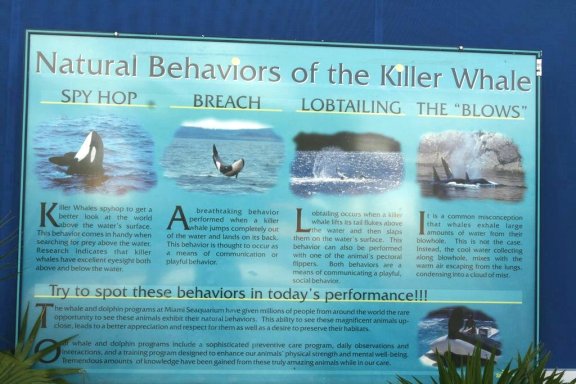
    The 'swim with dolphin' programs offered so widely are also just as bad, but not only for the dolphins. Studies have shown that being in the water with the dolphins puts people at risk from various bacteria and microorganisms. The full facts can be found here, as well as the full report on the hyperlink in blue. There have also been reports of dolphins trying to 'hump' people in the water, which may just seem like  innocent high jinks, but in fact may be very dangerous, especially if the person is a child or lesser-able bodied,  and the dolphin weighs up to 1200 lbs.  In fact, there is a video of such an incident on youtube. Note that it seems to be trained to perform such an action, as do the other dolphins in the other videos. Its appalling enough that any trainer would encourage that behaviour, let alone train it in the first place.The issue regarding 'dolphin therapy' is a complex one, and will be discussed in the later post- navy use of dolphins and whales, and dolphin therapy. So, back to the claims of education and conservation. Claims which are so ungenuine they are almost laughable. A few points to note here then, firstly the fact that the dolphins caught in Taiji who are sent to the Japanese oceanariums (in particular Taiji Whale Museum) to perform, are accompanied by their dead family members who are packaged in the restaurant for the paying visitors to eat during show intervals. Secondly, the Miami Seaquarium who claims to be educating the public about killer whales, and in fact has not got a clue. Their educational poster is totally incorrect, the 'false eye patch' does not exist.
Also, the other poster explaining 'natural' behaviour is laughable. The 'behaviour' seen in the show is trained and totally unnatural.


(Photos from Orca Network, Peter.P, 2007)

   I shall now briefly go on to explain some academic arguments against captivity, from the book The Animal Ethics Reader, 2nd edition, ed. Susan Armstrong and Richard Botzler. He argues against captivity for cetaceans, due to the mental and emotional consequences it has on them, and also the difficulty in keeping the facilities well managed. When talking about dolphins, he explains that 'for the most curious, exploratory, mobile, playful creature on the planet, an aquarium must be very boring indeed' (page 498). He also explains the morbidity of the life expectancy of captive dolphins and orcas, when compared to their natural life expectancy in the wild. He also stresses the need for social interaction for dolphins and whales in captivity. The human-dolphin relationship when under 'captive conditions' is so 'incredible' that is may prove how desperate the dolphins are to have a family-like bond and feel loved. It seems so meagre that they have to settle for the love and companionship of the paying customers and not their own kind.

  On that note, I end todays' topic, as I have so much to do and it is so late. I hope its been informative and I hope it wets your appetite for more. Believe me this is just the tip of the ice berg for captivity as a topic!! Good night. :)